Exercise 1: The function of books
- Christine Griever

- Jan 6
- 5 min read
Identify a range of books that have fundamentally different functions in terms of how these books are engaged with - how they’re held, where they’re read, by whom, and for what purpose. Try to look at least six books, but you can extend this if you want to. The differences between these books might be determined by their genres. For example, you might look at a cookery book, a biography of a sports personality, a travel guide, a work of historical fiction, a teenage film tie-in like Twilight, this course guide – the choice is yours.
Think about how each book’s form reflects its function. The front cover is an obvious starting point (and the focus on your upcoming assignment) but try to look more broadly than this. Think about things like page extent, paper quality, typeface, the weight of the book, imagery and more. Is the book illustrated with photographs, reproduced images or drawings? Are these concentrated in one or two places or distributed throughout the book?
What about front matter and end matter? Historical novels like Hilary Mantel’s Wolf Hall may have family trees and/or a list of characters as part of the front matter. A scholarly biography will usually have many pages of end-notes and references.
Reflect on this in your learning log, with examples of some of the books you’ve selected. Identify how each book designer has reflected the genre and function of your chosen books in their final design.
Introduction,
As I read through the exercise, I wanted to research the front matter and end matter further before describing the function of my chosen books. I'm not familiar with front matter and end matter. I want to become more acquainted with the terms.
Front matter:
comprises all of the sections in a book before the reader reaches the main contents of the book. The sections are as follows:
Half title: This page contains only the title of the book and is on the first page of the book.
Frontispiece: This page contains an image that is related to the book's theme or genre, which is located opposite the title page.
Title page: This page gives the reader the full title of the book, subtitle (depending on the book) and author.
Copyright page: Provides the reader with information about the publisher, edition (if applicable), copyright, ISBN number for the book and sometimes acknowledgements for the editor/designers/cover art.
Dedication: A page where the author of the book dedicates their work to a person or group of people.
Epigraph: To set the tone of the book, the author may put in a quotation at the beginning of the book.
Table of contents: To help the reader navigate the book, chapters or the book sections with page numbers.
Forward: Introducing the book to the reader, but written by another person who is not the author.
Preface: The author writes about their book and explains why it was written, the significance and purpose.
Acknowledgements: Individuals and/or organisations that helped the author write or create the book.
Accolades: Praise from critics, other authors, if the book was popular, highlighting the book's achievements. This page is before the reader reads the main content.
Introduction: Introducing the subject or section and providing more information before the main text.



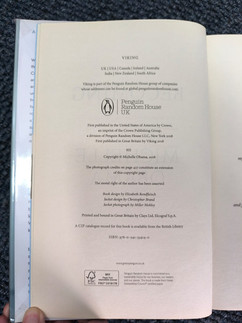
Frontispiece and half title pages Title page Copyright page





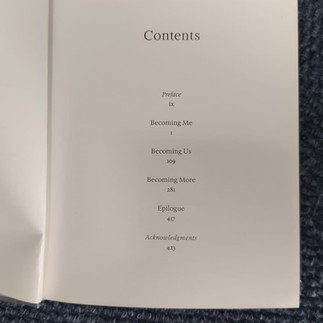
Dedication page Epigraph Contents page


Foreword Preface Accolades
Back matter:
Appendix: A combination of charts or extended explanations that don't fit into the main body of text.
Glossary: Usually technical explanations or definitions in the form of a list (a bit like a dictionary)
Bibliography: Referenced information from other sources such as newspapers, books, websites, etc or recommended reading.
Index: Listed in alphabetical order, the book names, subjects or other keywords with page numbers, helping readers find information quicker.
Endnotes: Citations or references placed at the end of the book instead of within the body of the text.
Colophon: Technical information about the book, such as the typeface, printing process and/or paper.
Author bibliography: A section at the end of the book about the author's other works (if any), qualifications, and experience.
Errata: Corrections to mistakes once the book has been published.
About the author: An extended version of the author's biography concentrated more on the life and career of the author.
Acknowledgements: Individuals and/or organisations that helped the author write or create the book. Sometimes placed at the beginning of the book.
Index of figures: Index of illustrations or tables that were used in the book.
Imprint page: Information about the publisher and/or printer or other details.


Appendix Glossary Bibliography




Index Author Bibliography Acknowledgements and imprint
It took a long time to review numerous books and take images of the examples that comprise the front matter and back matter of a book. Although I didn't find everything in the books, it still gave me a good idea of how the book is structured internally and that not all books have all of the sections. I now have a much better understanding and feel more confident in reviewing the different formats of books and their functions.
The function of books
I chose some diverse books from different genres that I thought might be good to analyse their function and engagement.
Please click on the link to see the extensive table of different books I analysed.

Reflection
I learned so much from this exercise. I wasn't familiar with the terms used to describe the front and back matter of books. I knew there were contents pages and appendices, but I didn't realise that these components make up a list of key elements. I'm glad I took the time to research this fully, as I now have a much better understanding of how these different components are used and put into books.
I also learned that not all books will use all of these components. It really depends on the type of book being published. For example, I found that a textbook has different front and back matters compared to a children's book. Each genre of book is designed with a specific purpose and target audience in mind.
I also found it interesting to see the physical differences in how various books are made. For instance, some are made with a higher GSM paper than a book like the Bible, which used a special type of paper called scritta. This isn't just an aesthetic choice but a practical one as well. Printing a Bible with a higher GSM and a larger typeface would make the book incredibly heavy and very expensive to produce. In contrast, a special edition children's book like "The Very Hungry Caterpillar" can use a higher GSM and a hardback cover because it has fewer pages. I found it fascinating that a book's design can change depending on its intended use.
References
Bible. (2002) New International Version. USA: Zondervan
Carle, E. (2019) The Very Hungry Caterpillar. UK: Puffin
Dorling Kindersley (2018) Top 10 Singapore. London: Penguin Random House
Hosseini, K. (2004) The Kite Runner. London: Bloomsbury Publishing
National Geographic (2022) Concise Atlas of the World. Washington: National Geographic Partners LLC
Obama, M. (2018) Becoming. USA: Penguin Random House.
Tortora, G. and Grabowski, S (2000) The Principles of Anatomy and physiology. (9th Ed.) John Wiley and Sons Inc.
van der Merwe, I. (2019) Cape Mediterranean, the way we love to eat. Cape Town: Struik Lifestyle, an imprint of Penguin Random House.


Comments