Research Task1: Exploring Artists' books
- Christine Griever

- Mar 21
- 4 min read
Find two artists’ books that you feel demonstrate an interesting relationship between their form and content through the materials that the artist has chosen to use. Reflect on these books in your learning log.
If you have physical access to libraries such as The British Library, Tate Library Special Collection, or Leeds University Library, visit them and have a look at examples of artists’ books in their special collections. Libraries have online resources as well with access to their collections, for example the V&A National Art Library. Alternatively, return to the The Smithsonian Library’s online archive of artists’ books: https://library.si.edu/collection/artists-books
You may also want to reread the Artists’ Book section in Part One of this unit.
Linda Newbown
I wanted to find an unusual artist's book, and on Google Arts and Culture, I discovered "Tennis Ball". This book is made from an old tennis ball that opens up like a book, with pages measuring 64 x 64 x 64 mm. The artist has transformed the tennis ball's original function, giving it new meaning while still providing the reader with the physical, tactile and sensory experience of handling a tennis ball.
I appreciate this book concept because it repurposes the tennis ball, similar to the idea of recycling. The artist alters our perceptions of what a book can be, making it a physical experience for the reader. This approach reminds me of designer Irma Boom, as both encourage readers to engage actively with the book.





Fig. 1 Tennis Ball (2001)
"The Tennis Ball book was made in response to the dichotomy of book as object and book as information. A book is a difficult thing to define because half of it is object and half is an abstract concept. Is a book the sum of certain requisite characteristics? If a book has no pages is it still a book? If it cannot be opened is it still a book? These are the things I like to ask as I make my books. My artists' books are a way of questioning bookishness". - Linda Newbown.
Allison Cooke Brown
While researching unusual artists' books, I visited the National Museum of Women in the Arts website. There, I discovered a variety of artists' books that I initially thought wouldn't qualify as traditional artists' books, as many resemble installations. However, "Teatimes" caught my attention because it transforms something as ordinary as a teabag into snippets of her journal, all packaged in a handmade box.
What I found particularly interesting was that each teabag contained journal entries written in sepia ink. As a reader, you become fully immersed in the experience of engaging with the book by unfolding each teabag to read its thoughts. I appreciate how the artist utilised mixed media in creating this book, including different elements such as bone fasteners, teabags, the handmade box and sepia ink with silk covering. This artist really wants readers to take part in the experience, where they can read and reflect.


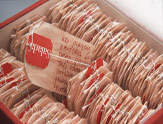
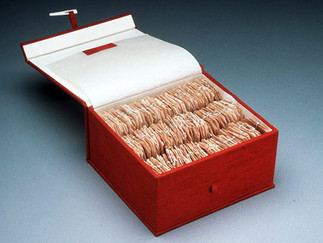
Fig. 2 Teatime (2005)
"In Teatimes, I recorded my daily ritual of pouring a cup of tea and writing in my journal. From a case that replicates a Salada tea box, the reader selects and unfolds an empty tea bag and discovers a fragment of a journal entry. Where once there were tea leaves, now there are reflections written in sepia ink. There is a distinct contrast between the bag’ exteriors, with their bright red commercial labels and declarative statements, and the unwrapped interiors, with handwritten personal musings. Private thoughts are steeping". – Allison Cooke Brown
Reflection
I spent a long time trying to find an art gallery or museum in South Africa that would have artists' books on display or an exhibition. I wanted to showcase South African Artists'. However, my continuous frustration with trying to access museums with crumbling infrastructure and mismanagement just added to it. In the end, I had to resort to online research, which is a shame, as I feel a great opportunity to showcase South African artists' work was missed.
When I first encountered artists' books earlier in the course, I learnt that artists' books were unique and could be made from anything and be about anything! I found books made with pressed flowers, cyanotype, collage and paint. However, this time I wanted to see more extreme artists' books that seemed more unusual than the ones I first researched. I'm glad my perseverance paid off because I found really unusual artists' books made from tennis balls and tea bags!
When I first started this module, I wasn't sure what an artist's book was. However, as I have progressed further into the course, I have come to appreciate the books as works of art. I like the exclusivity of the books being limited edition and meticulously made, from the handmade paper to the way the books are bound. What I have really appreciated is the personal experience of handling the book and the tactile feel it gives the reader. My latest research, using a tennis ball as the book and teabags, was such a good idea that it further questions the functionality of the book.
References
Cooke-Brown, A. (2005) Teabags. At: http://www.allisoncookebrown.com/teatime.html
(Accessed: 18/01/2026).
Seaman, E. (2014) Teatimes. At: https://emilyseaman.wordpress.com/2014/03/20/teatimes-2005-allison-cooke-brown/ (Accessed:18/01/2026).
National Museum of Women in the Arts. (2026) The Book as Art: Unbound Books The Book as Art: Unbound Books. At: https://nmwa.org/whats-on/exhibitions/online/book-art-unbound-books/ (Accessed:18/01/2026).
Newbown. L. (2001) Tennis Ball. Canberra, A.C.T. :Boundary Press. At: https://artsandculture.google.com/asset/mgF_tUO51zbB7w?childAssetId=SwFy2ZnT0SudzA&hl=en
Images
Fig. 1 Newbown. L. (2001) Tennis Ball. [Photograph] At: https://collections.slq.qld.gov.au/viewer/IE6109605 (Accessed: 18/01/2026).
Fig. 2 Cooke-Brown, A. (2005) Teabags. [Photograph] At: http://www.allisoncookebrown.com/teatime.html (Accessed: 18/01/2026).


Comments